
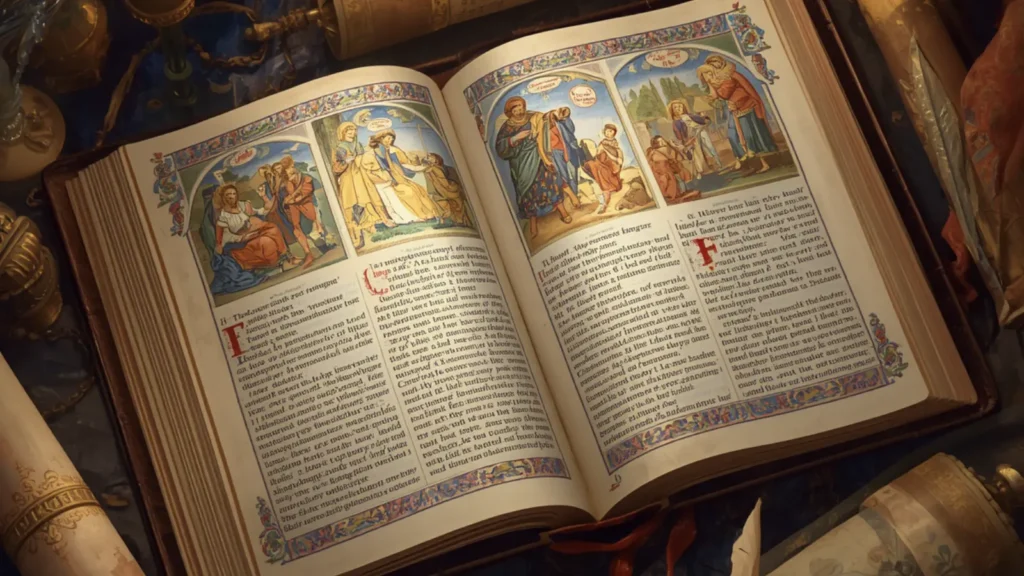
The chapters of the Bible total 1,189 in the standard Protestant canon929 in the Old Testament and 260 in the New Testament.
These divisions were not part of the original Hebrew, Aramaic, or Greek manuscripts.
Added centuries later primarily through the work of Stephen Langton in the early 13th century, they serve as practical tools for navigation, reference, teaching, and daily devotion while the inspired text itself remains unchanged.
Key Takeaways
- The modern chapter system largely traces to Archbishop Stephen Langton around the early 1200s and became standardized through Paris Bibles.
- Original biblical writings used continuous text or natural paragraph-style breaks; chapters and later verse numbers are helpful human additions.
- Psalms contains the most chapters (150); several short books contain only one.
- Chapters aid memory, preaching, cross-referencing, and consistent Bible reading plans without replacing contextual study.
- Understanding the history of chapters strengthens appreciation for Scripture’s accessibility and God’s providence in preserving His Word.
Why the Original Scriptures Lacked Numbered Chapters
Ancient Jewish and Christian manuscripts presented Scripture as continuous text. Scribes used paragraph breaks, blank lines, or early section markers in some traditions, but nothing resembling today’s numbered chapters. The Hebrew Bible (Tanakh) relied on sense units and later Masoretic notations. Greek New Testament manuscripts employed systems such as kephalaia or Eusebian canons for the Gospels that differ from modern divisions.
This continuous form reflected how the texts were written, copied, and heard in community worship and teaching. The absence of chapters does not diminish inspiration; it highlights that the message itself—God’s revelation—stands independent of later organizational aids.
Stephen Langton and the Birth of Modern Chapter Divisions
Stephen Langton (c. 1150–1228), English scholar, University of Paris teacher, and later Archbishop of Canterbury, is the figure most closely associated with the chapter system used today. Working in the early 13th century, he developed divisions suited for university study, preaching, and reference. These appeared in the influential Paris Bibles and spread rapidly.
Earlier attempts at division existed, and some scholars note possible influences from English monastic practices or earlier Latin traditions. Langton’s schema, however, achieved widespread adoption because it balanced length, content, and usability. Slight refinements occurred later, yet the framework remains substantially the same.
How Chapter Numbers Spread Across Languages and Traditions
Once established in Latin manuscripts, the system migrated into Hebrew Bibles (with Jewish scholars adopting the numbers for reference) and Greek texts. Printed Bibles carried the divisions into vernacular translations. The Geneva Bible (1560) and subsequent English versions helped fix the system for English-speaking readers. Jewish, Catholic, Orthodox, and Protestant traditions largely share these chapter numbers even when book order or deuterocanonical content differs.
Total Chapters Across the Protestant Bible
Most Protestant English Bibles contain 1,189 chapters:
- Old Testament: 929 chapters across 39 books
- New Testament: 260 chapters across 27 books
Catholic and Orthodox canons include additional books, increasing the overall count, yet the core chapter numbering for shared books remains consistent.
Old Testament Chapter Landscape
The Old Testament’s 929 chapters span law, history, poetry, and prophecy. The Pentateuch alone holds 187 chapters. Historical books contribute a substantial portion, while the poetic and wisdom books—especially Psalms—dominate length. Major prophets such as Isaiah (66) and Jeremiah (52) provide extended prophetic material; the twelve Minor Prophets together total only 67 chapters.
This distribution reflects the varied literary genres God used to reveal Himself to Israel and prepare the way for the Messiah.
New Testament Chapter Distribution
The New Testament’s 260 chapters focus on the life of Jesus, the early church, and apostolic instruction. The four Gospels total 89 chapters. Acts adds 28. Paul’s letters (including Hebrews in traditional counting) contribute around 100, while the General Epistles and Revelation complete the collection. Matthew and Acts each have 28 chapters—the highest in the New Testament.
These shorter books and concentrated teaching make the New Testament especially suitable for sequential chapter reading.
Longest and Shortest Chapters of the Bible
Psalms 119 stands as the longest chapter, an acrostic masterpiece celebrating God’s Word. Psalm 117 is the shortest. Several books consist of a single chapter: Obadiah, Philemon, 2 John, 3 John, and Jude. These extremes illustrate both the breadth of Scripture’s praise and the power of concise apostolic messages.
Verse Divisions: A Later Development
While chapters arrived in the 13th century, verse numbers came later. For the Old Testament, Jewish scholars refined verse divisions over time. For the New Testament, the French printer and scholar Robert Estienne (Stephanus) introduced the system still used today in his 1551 Greek New Testament. Legend claims he worked while traveling; more accurately, the work occurred during a journey, with some divisions reflecting practical rather than purely literary considerations.
Together, chapter and verse references revolutionized Bible study, preaching, and the creation of concordances.
Practical Benefits for Personal Bible Reading
Chapter divisions make consistent reading plans possible. Many believers read one or more chapters daily, complete the New Testament in a few months, or follow annual whole-Bible schedules. The structure supports memorization of key passages, group discussion, and locating familiar texts quickly during personal devotion or counseling.
How Chapters Serve Preaching and Teaching Ministry
Pastors and teachers rely on chapter references for sermon series, Sunday school curricula, and small-group studies. A series through the Gospel of John or the book of Romans becomes manageable when framed by chapters. Cross-references and topical studies also depend on this shared system.
Potential Limitations of Artificial Chapter Breaks
Chapters do not always align with natural literary or theological units. A single narrative may span chapter boundaries, or a chapter may begin mid-thought. Readers therefore benefit from studying paragraphs and literary context rather than treating chapter numbers as rigid containers of meaning. Responsible interpretation always prioritizes the original flow of the text.
Chapters and the Doctrine of Scripture
Passages such as 2 Timothy 3:16–17 affirm that “All Scripture is breathed out by God and profitable for teaching, for reproof, for correction, and for training in righteousness.” The chapter system does not create this authority; it simply helps believers access the God-breathed text more readily. Psalm 119 repeatedly celebrates the life-giving power of God’s Word across its 176 verses—itself the longest chapter.
Jesus and the apostles quoted and alluded to Scripture without modern chapter numbers, demonstrating that the message, not the later apparatus, carries divine authority.
Using Chapters for Spiritual Growth and Discipleship
Reading consecutive chapters cultivates familiarity with the whole counsel of God. A believer who moves steadily through the Gospels encounters Jesus’ teachings in context. Progressing through the Epistles builds a coherent understanding of Christian living, grace, and hope. Chapters become stepping stones rather than isolated units.
Reflection Questions for Deeper Engagement
- How does knowing the chapters were added later affect your view of Scripture’s authority?
- Which books or sections of the Bible have you primarily encountered through isolated chapters rather than continuous reading?
- What reading plan using chapter divisions might strengthen your walk with Christ this season?
Bible Study Tips Centered on Chapters
Read an entire chapter aloud when possible. Note the flow of argument or narrative before isolating individual verses. Compare parallel accounts in the Gospels by chapter. Use chapter headings in study Bibles as starting points, then verify against the text itself. Journal one key insight or application from each chapter.
Prayer Prompts Drawn from Scripture’s Structure
Thank God for the preservation and accessibility of His Word. Ask the Holy Spirit for insight as you open a new chapter. Pray through the themes of a chapter—praise from Psalms, repentance from the prophets, faith from the Gospels, or perseverance from the Epistles. Let the structure serve communion with God rather than mere completion of a checklist.
Common Misconceptions About Chapters of the Bible
Some assume chapters and verses are original and therefore carry interpretive weight equal to the words themselves. Others treat chapter breaks as absolute thematic boundaries. Still others view the system as purely modern invention without recognizing its medieval scholarly roots and rapid acceptance across traditions. Clarity on history corrects these views and fosters wiser reading.
Integrating Chapter Awareness into Daily Christian Living
Carry a chapter-a-day habit into ordinary routines—morning coffee, lunch breaks, or evening wind-down. Share a chapter summary with family or a friend. When anxiety or decision-making arises, turn to familiar chapters that have shaped your faith. Let the organized form of the Bible support a life ordered around God’s truth.
Frequently Asked Questions
How many chapters are in the Bible?
The standard Protestant Bible contains 1,189 chapters: 929 in the Old Testament and 260 in the New Testament.
Who divided the Bible into chapters?
Stephen Langton, Archbishop of Canterbury, is the figure most credited with developing the modern chapter divisions in the early 13th century.
When were verses added to the Bible?
New Testament verse numbers were introduced by Robert Estienne in 1551. Old Testament verse divisions developed earlier within Jewish tradition.
Which book has the most chapters?
Psalms has 150 chapters, the highest of any biblical book.
Are chapter divisions inspired?
No. The original manuscripts lacked them. Chapters and verses are useful human tools that facilitate study without altering the inspired text.
Why do some chapter breaks feel awkward?
Because the divisions aimed at roughly manageable length for study and reference rather than perfect literary units. Context remains essential.
Do Catholic and Protestant Bibles share the same chapter numbers?
Yes for the shared books. Additional deuterocanonical material increases the total chapter count in Catholic and Orthodox Bibles.
How can I use chapters for a Bible reading plan?
Choose a plan that assigns one or more chapters daily. Many free plans cover the New Testament in 90 days or the whole Bible in a year.
What is the shortest chapter in the Bible?
Psalm 117 is the shortest chapter.
Should I always read full chapters?
Reading full chapters is excellent for context, yet shorter focused study of paragraphs or key verses also has value when done carefully.
Did Jesus use chapter numbers?
No. Jesus and the apostles quoted Scripture by content or traditional references available in their day.
How do chapters help with memorization?
Numbered chapters create mental landmarks that make locating and recalling passages easier over time.
The chapters of the Bible stand as a gift of historical providence that makes the living Word more approachable for every generation.
While the original authors wrote without numbered divisions, the system we inherit enables ordinary believers to open Scripture with confidence, follow its unfolding story, and apply its truth.
Approach each chapter not merely as a unit to finish but as an invitation to meet the God who speaks through every page.
Let the structure serve the substance, and let the substanceChrist and His gospeltransform daily life.

